Wednesday, January 14, 2009

Enter Three Witches by Caroline Cooney


Enter Three Witches by Caroline Cooney

Review by Cindy Bohn


Lady Mary is a ward of the Macbeths. Yes, those Macbeths. The ones in the play. She is beautiful, rich, and sweet. She has a perfect life. Until her father is captured as a traitor to the king and executed. Her lands are given to Macbeth and she is expected to work in the kitchen. From idle rich to scullery maid in one day.


Lady Mary begins to notice some odd things happening in the castle. First she saw Macbeth speaking with some witches. Then she saw Lady Macbeth reading a letter, something quite out of the ordinary. And then the king himself comes to stay at their castle and his shockingly and cruelly murdered.


I really enjoyed this book for teens. I am a sucker for Shakespeare-based stories, and Macbeth is probably my favorite play. So when I saw this book, I had high hopes. Cooney does an excellent job portraying the customs and manners of the day. The new characters are woven nicely into the original story, and they become so real. Lady Macbeth is especially well done. I wasn't as perfectly pleased with Macbeth himself - I felt that his motivation and his character remained a little mysterious. But overall, I was swept away.


Enter Three Witches has some difficult themes-witchcraft, religion, loyalty, ambition. I would recommend it for any older teen or adult.

Wednesday, January 7, 2009

Lady of Quality by Georgette Heyer


Heyer, Georgette. 1957. Lady of Quality.

Review by Becky Laney of Becky's Book Reviews

"The elegant travelling carriage which bore Miss Wychwood from her birthplace, on the border of Somerset and Wiltshire, to her home in Bath, proceeded on its way at a decorous pace." (1)
Lady of Quality's first line may not sparkle as much as Austen's famous one, "IT is a truth universally acknowledged, that a single man in possession of a good fortune must be in want of a wife." But just give it time. Trust me. This one has everything and more that you'd expect in an Austen novel: wit, humor, romance, quirky characters, as well as a few genuinely likable ones.

Such is the case with Lady of Quality. Miss Annis Wychwood is almost thirty years old. And in that time, the Regency period, thirty might as well have been sixty. Spinster is spinster no matter if you're thirty, blond, and witty or wrinkly, gray, and stubborn. But Annis is comfortable in her singleness. Or at least she prefers to see herself as comfortable. It helps that in Annis' situation, she's wealthy enough to have her own house and household. (By household I mean servants and such). If Annis had to live under her brother's roof, well, it would be a different story altogether. She does NOT get along with her brother, Geoffrey, though she does get along in a way with her sister-in-law. Yes, folks might think it a bit strange that she'd rather be independent and living on her own--and a good day's travel away from her brother and his wife--but they've become accustomed to it. But when our novel opens, Annis is about to do something a bit more unexpected, a bit more shocking.

Lucilla Carleton is just a young thing--not even eighteen--when she decides to run away from her aunt. (Her aunt is her primary guardian.) Her aunt wants her to marry the son of her father's best friend. A man, Ninian, that she's practically grown up with. It's not that she doesn't like him. But she doesn't like him like him. At least she says as much. As does he when given the opportunity. (The two like to bicker about how they don't want to be together.) Annis comes across this bickering pair on her way to Bath. Their carriage (or vehicle) has broken down--a problem with one of the wheels. Annis is too much of a lady to leave the poor girl in distress. She invites the young woman to come with her, to stay with her. Through their trip and the first day back at home, Annis hears all about Lucilla, her aunt, Ninian, and his over-bearing parents the Lord and Lady Iverley. Lucilla has runaway it's true but it's because her aunt is passive aggressive. She manipulates through tears and pleas and looks.

What is Annis to do? Welcome her home to this girl she barely knows yet instantly likes? Or send her packing with much tears of distress? She decides that the girl must write a letter to an aunt. She'll be allowed to stay with Miss Wychwood in Bath, it's true, but it's a temporary solution to the girl's problem. But this nice letter home has unattended results. Her aunt being of the nervous sort on the best of days writes a letter--a tear-soaked and illegible letter to the girl's legal guardian--Lucilla's Uncle Oliver. Oliver Carleton.

The last thing Annis expected was to be visited by Oliver Carleton. A man (from London) with the reputation of the worst sort. A truly grumpy, stubborn sort of man who speaks without thinking of the consequences, who enjoys speaking the truth, the whole truth, and nothing but the truth come what may. Obey society's nicety-nice rules? Not a chance! A man with a sharp but witty tongue comes to Bath to get to the bottom of this mess. He doesn't want Lucilla. He's not there to take her away, he's there to investigate this woman, this stranger who has interfered and butted into his business, his family.

Let the fun begin.

Oliver and Annis. Oh the sparks will fly. Despite her claims of being ancient and spinsterly, Oliver can't help thinking that she's entirely unsuitable for chaperoning his niece. She should be the one being courted and pursued and wooed by men. She's beautiful. She's witty. She's intelligent. There's just a certain something about her that he can't ignore. Annis never in a million years thought she'd feel this way, this maddeningly confusingly wonderful feeling. She can't stand him; and yet, she keeps hoping she'll see him again.

For anyone who loves Much Ado About Nothing and/or Pride and Prejudice, Lady of Quality is for you. It is a wonderfully giddy-making novel.

Heyer's novels are rich in detail combining history and romance with wit and charm and some unforgettable characters. If you're looking for a place to start, I'd highly recommend beginning with Lady of Quality.

Monday, June 23, 2008

The Hobbit by J.R.R. Tolkien


Tolkien, J.R.R. 1937, 1966. The Hobbit.

Review by Becky Laney, frequent contributor.


In a hole in the ground there lived a hobbit. Not a nasty, dirty, wet hole, filled with the ends of worms and an oozy smell, nor yet a dry, bare, sandy hole with nothing in it to sit down on or to eat: it was a hobbit-hole, and that means comfort. (3)


Hobbits do like to be comfortable. That is a fact. But in The Hobbit, we read of one hobbit in particular, a Mr. Bilbo Baggins, who leaves his life of comfort behind him to go on a once-in-a-lifetime adventure with thirteen dwarves and one wizard. It is the story of how he went from being a respectable hobbit to a very unrespectable, "odd" little hobbit. Bilbo never meant to have an adventure. He was quite clear on that. But never say never. It all starts with a visit from a wizard, Gandalf. That visit leads to another visit--a visit by thirteen dwarves--who call upon him unawares and give him the surprise of his life. They want him--they expect him--to be a part of their expedition, their adventure, their journey to go off and kill a dragon, Smaug by name, and steal his treasure. It's laughable almost, at least at first, but slowly and surely Bilbo gets carried away with it all. And the adventures that follow--oh my!


The Hobbit is a charming and delightful though-not-a-thin adventure book that everyone should read. (Or at least attempt to read! By that I mean, while I loved it--while I think many many people love it--I suppose no one book can please everyone. But this one should at least be attempted, tested to see if you like this sort of thing.)

Monday, May 5, 2008

Beezus and Ramona by Beverly Cleary


Cleary, Beverly. 1955. Beezus and Ramona.


Review by Becky Laney, frequent contributor.


Originally published in 1955, Beezus and Ramona is a true children's classic. Beezus, age 9, and Ramona, age 4, are the stars of Beezus and Ramona. This story is told from Beezus' perspective. (I believe the others in the series are told from Ramona's perspective.) This is how it opens: "Beatrice Quimby's biggest problem was her little sister Ramona. Beatrice, or Beezus (as everyone called her, because that was what Ramona had called her when she first learned to talk), knew other nine-year-old girls who had little sisters who went to nursery school, but she did not know anyone with a little sister like Ramona." If you've read any of the Ramona series, you know what she's talking about. Ramona. That love-to-hate, pesky little sister who is always into something. She has to be one of the best-loved, most-memorable characters ever created.


In Beezus and Ramona, we see the family dynamics of the Quimby household and the tension between two sisters. Beezus is almost perpetually frustrated with her younger sister. And Ramona is well, Ramona. Prone to wanting what she wants when she wants it.


I must have read this series dozens and dozens of times growing up. But I haven't read it recently. I probably last read it in 1999. Ramona is just as great as I remembered it. Each chapter has a scene that I almost know by heart. From the opening chapter, where Ramona's fascination with steam shovels lead her to destroy a library book, to the last chapter where Ramona's imaginative "acting-out" of Hansel and Gretel leads her to bake her doll, Bendix, in the oven and ruin her sister's birthday cake in the process.


I highly recommend this series to readers young and old. I think they make especially nice read-alouds!

Wednesday, April 16, 2008

Daddy-Long-Legs by Jean Webster


Daddy-Long-Legs by Jean Webster


Review by Natalie Smith, our new regular contributor

I found Daddy-Long-Legs in a paperback reprint on the shelf of the YA section of my library – and loved it so much that ten years later I special-ordered copy and ended up with a second edition, published in 1912! Daddy-Long-Legs begins on the first Wednesday of the month, the day on which The Trustees visit the John Grier Home. It’s an orphanage where Jerusha Abbot lives with ninety-six other children, but she’s seventeen and on the brink of being thrust out into the world, and doesn’t quite know what will become of her. One of The Trustees is a philanthropist, and after reading an essay she’d written about “Blue Wednesday”, decides to send her to college to become a great writer.

The first chapter of this story is told in third person, but the rest of it is a compilation of all the letters Judy, as she decides to call herself, sends to her benefactor, whom she decides to call “Daddy-Long-Legs”. The letters are rich and full of all the innocence and excitement that comes of being seventeen in this era, and from being free for the first time in her life from her usual duties to the John Grier Home. Taking care of one person is considerably easier than taking care of eleven small children – and Judy really enjoys almost every aspect of her independent college life.

Some of my favorite things about this sweet book are the way I learned so much about the historical time period through the things Judy writes, and the similarities between my own college experience and Judy’s. There are about ninety years between Judy’s college days and my own, and while there were definitely some things that haven’t endured the years, overall I found more similarities between fictional Judy and real-life me than I was expecting.

I recommend this book to ANYONE who enjoys Anne. It’s much faster-paced, but the tone is very similar to L.M. Montgomery. And if you don’t know who Anne is (heaven forbid!), you should read her, too!

Monday, March 31, 2008

Mrs. Frisby and the Rats of NIMH by Robert C. O'Brian


O'Brian, Robert C. 1971. Mrs. Frisby and the Rats of NIMH


Review by Becky Laney, frequent contributor


Mrs. Frisby, the head of a family of field mice, lived in an underground house in the vegetable garden of a farmer named Mr. Fitzgibbon.


Mrs. Frisby and the Rats of NIMH won the Newbery in 1972. This was my first time to read it. My first impression? Slightly odd, but odd in a good way. A really good way. It took me a few chapters to suspend my disbelief. Talking animal books while aren't completely foreign to me, aren't my norm usually. But once I allowed myself the opportunity to really embrace the story for what it was--fantasy not realistic fiction--then I was more than hooked.


The story is about the Frisby family. Mrs. Frisby is the head of the family. It is winter, and one of her children, Timothy, is sick. She's told by the "doctor" mouse that to move her son would result in his death. Yet move they must if they're to survive. For spring has come. The thaw has begun. The frost is long over. And she overhears the farmer making plans to get out the tractor. Her home--their home--is in the field. Their home is a "slightly damaged cinder block" that is almost completely underground. The story is her search for help. It is this search for help which will lead her directly to the rats.


Mrs. Frisby is afraid of the rats. Almost everyone is afraid of the rats. But when her son's life hangs in the balance...it's a time for a mother to overcome her fears--all her fears--even if those fears are rats and owls and crows.


I definitely recommend this book. It was fun and enjoyable.

Wednesday, March 26, 2008

All of a Kind Family by Sydney Taylor


Taylor, Sydney. 1951. All Of A Kind Family.


Review by Becky Laney, frequent contributor.


Originally published in 1951, Sydney Taylor's novel, All of A Kind Family, is set in New York City around 1912. The family consists of a mom, a dad, and five "step and stair" daughters. (They range in age from twelve to four.) The book is about the adventures the five sisters have together. It's definitely not your typical book if you're judging it by modern standards. There is less plot, for one thing, but the charm--or part of the charm--is in the individual stories, the episodes. The fact that it is more a compilation of loosely connected stories masquerading as a novel isn't a problem in my opinion. (But I'm curious what modern children would make of it all???)


The book does have its charms. There's no doubt about that. And one of the things I do like about the book is the fact that it highlights so many different aspects of being Jewish. For example, I haven't come across too many fiction novels (or picture books for that matter) that show families celebrating Purim and Succos. (These aren't the only celebrations by any means.) It was just interesting to see these aspects of culture and religion interwoven with the typical and traditional threads of family life and social life--going to school, going to the library, going to the beach, going shopping, getting a new baby, etc.


Part of me is curious as to how modern readers would respond to this novel and others like it. Would it be considered too old fashioned? Too dated? Too boring? While I can appreciate it the novel as an adult, I'm not sure what I would have thought of it as a child.

Monday, March 17, 2008

Understood Betsy by Dorothy Canfield Fisher


Fisher, Dorothy Canfield. 1917. Understood Betsy.

Review by Becky Laney, frequent contributor.


When this story begins, Elizabeth Ann, who is the heroine of it, was a little girl of nine, who lived with her Great-aunt Harriet in a medium-sized city in a medium-sized state in the middle of this country; and that's all you need to know about the place, for it's not the important thing in the story; and anyhow you know all about it because it was probably very much like the place you live in yourself.


Elizabeth Ann is an orphan raised by her great-aunt Harriet and her aunt Frances. The first chapter shows the reader just how life as she knew it was for Elizabeth Ann. To say she was coddled would be a bit of an understatement. To say that both aunts and niece were a bit psychologically unsound would be a bit closer to the truth. It's not that they're crazy crazy. It's just that they're anxious, jittery, nervous, worrisome, panicky, fidgety, chicken-little-y type people. They're sweet and docile enough, but they lack gumption and ingenuity and vitality.


Understood Betsy is the story of how Elizabeth Ann transforms into Betsy. It all starts when one of her caretakers gets diagnosed with an unnamed disease. (If they named it, I sure missed it. But I think the main point was to get the two aunts out of the picture.) Elizabeth Ann is sent to live with the other side of the family. Her aunt (Abigail) and uncle (Henry) and first cousin (Ann). They live in Vermont, I believe.


From the very beginning, Elizabeth Ann knew that she was entering the unknown. On her way to her new home--in the buggy--she has her first enlightened moment. "It is possible that what stirred inside her head at that moment was her brain, waking up. She was nine years old, and she was in the third-A grade at school, but that was the very first time she had ever had a whole thought of her very own." (21)


Her awakening, her transformation is entertaining enough and the descriptions of life and family are charming as well. I think some readers will love Betsy, understand Betsy; but I'd be silly if I didn't acknowledge the fact that some readers would find Understood Betsy to be boring or quaint. Anyway, long story short...I loved it. I thought it was great. If I had discovered this as a child--like my mother did and most likely my grandmother did--I'm sure I would have loved it. I'm sure I would have read it over and over again.


You can find the entire book--including illustrations--online.

Friday, March 14, 2008

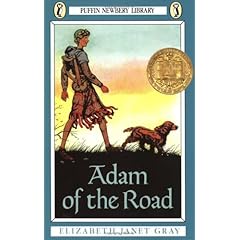
Adam of the Road by Elizabeth Janet Gray


Gray, Elizabeth Janet. 1942. Adam of the Road.


Review by Becky Laney, frequent contributor.


After a May as gray and cold as December, June came in, that year of 1294, sunny and warm and full of birds and blossoms and all the other happy things the songs praise May for.


Adam of the Road is one of those titles that I most likely never would have read without some encouragement and pressure. I avoided it as a child. Why? Mainly the cover I think. It didn't look like my kind of book. It still doesn't look like my kind of book. A boy in a skirt with a dog? However, appearances can be deceiving.


I am very glad that I read this one. Set in the thirteenth century, it is the story of a young boy, Adam. Adam is the son of a somewhat mostly successful and popular minstrel named Roger. (It's not like Roger is the most famous minstrel of all time with legions and legions of fans clamoring for him. But he's good at what he does and he always finds work.) When the book opens, Adam is at a monastery--an abbey. He's staying with the monks and attending their school until his father returns. His best friend is a dog named Nick, a red spaniel. But his other best friend is a boy named Perkin.


When his father returns, all seems well. In fact, they've never been better. They're reunited. Father. Son. Dog. The father has been hired by a well-to-do man on a semi-permanent basis. He's found a benefactor or sponsor you might say. I'm not really too familiar with the terms and the arrangements of medieval minstrels. And his father has been rewarded with a horse. They are to live for a while with this man on his estate. Adam will be around kids--both girls and boys--his own age. And there are some truly happy times spent there.


However, the good times don't last forever. After the big family wedding, father and son are once again on their own until the next big celebration or holiday or whatever. What's worse? After the wedding, Roger gambled and lost not only his money but his new horse. What's even worse than that? The man who won him doesn't know how to treat a horse? What's even more wore than that? The man has been wanting Nick. He's been watching Nick closely. He's made several offers. He won't be satisfied until the dog is his. And being a true villain, the deed is soon done.


Adam is angry and determined. Determined to follow this man--a fellow minstrel--as long as it takes in order to find his dog and get him back, this father and son team head off on his trail. But tracking this dog down isn't easy. The road is full of danger in more ways than one. It's not long after that Nick isn't the only one that is "lost." Adam and Roger become separated during the chase and have a monstrously difficult time getting reunited.


I was hesitant to say that much. However, the jacket flap clearly states that Adam is on the road alone searching for his father and for his dog.


What the description fails to hint at is that the book is actually interesting. The cover and description don't really do the book much justice. I think sometimes it's easy to assume that kids won't be interested in reading historical fiction. And to a certain degree, I agree. I think it is sometimes harder to sell historical fiction than fantasy for example. But I think for certain readers, Adam of the Road can still entertain even after all these years.


Adam of the Road won the Newbery in 1943.

Monday, February 18, 2008

Prince Caspian by C.S. Lewis


PRINCE CASPIAN by C.S. Lewis.

Review by Becky Laney, frequent contributor


Prince Caspian, the second of the novels in the Chronicles of Narnia series, takes place one year after the close of The Lion, The Witch, and the Wardrobe. The four children, Peter, Susan, Edmund, and Lucy, are preparing to return to school when they're instantly, magically transported (or translated) to Narnia. What they find there shocks them. Shocks them for many reasons. You see, it hasn't been a year in Narnia time. It hasn't even been just a hundred years. Their castle, their lands, unrecognizable ruins. The adventures are about to begin. Again. Many surprises, many adventures await them, along with one old friend. A friend that takes a little more faith to recognize these days.


Prince Caspian centers on a new hero. Caspian. The son of Caspian the Ninth, king of Narnia. But it is Caspian's uncle, King Miraz, that rules the land, and rules it harshly. Gone are the days of talking animals and other fantastical creatures. No the "old Narnians" must hide if they are to survive at all. Caspian may have been raised by his aunt and uncle, but his upbringing was left to an old nurse who believed in the old ways. Now, Caspian is a young man who longs to restore the golden days of the past. Who longs to restore Narnia to its former glory. Who longs to create a peaceful age where old Narnians can live and live well. But he can't do it alone. What he needs is help. Divine help.


Can a horn of old bring much-needed help from afar?


I love Prince Caspian. I do. It is exciting. It is thrilling. Again, Lewis has created memorable characters and memorable scenes.

Monday, February 11, 2008

The Lion, The Witch, and the Wardrobe by C.S. Lewis


Review by Becky Laney, frequent contributor.


My review of C.S. Lewis' classic children's book The Lion, The Witch, and the Wardrobe is going to be chatty--quite chatty--and there's nothing I can do about it. I first encountered the magic of Narnia in fourth grade when my teacher read it aloud to us. My teacher, Mrs. Watts, was known for many things. She inspired much fear and trembling. Like Aslan, she was not safe, but good. While, other students may remember the discipline or the hard work...I'll always remember my magical introduction to Narnia. Soon after, I added book by book the series to my collection. Most of my copies were used. Most were ugly. But I devoured each one. I seem to remember my sister reading a few of the series at least. But unlike Little House and Ramona and Anne, this series was more me and less her. Narnia belonged to me--the magic, the wonder, the glory of it all. I remember the pure pleasure I experienced each and every time I opened up a book. I remember the book covers, yes. And I definitely have strong opinions on which book covers through the years are 'the best' of the bunch. But more precisely, I fell in love with the proper order of the series. Few things irritate me more than someone who insists on that new-fangled order. Which is why, if you could see me, you'd know how frustrating it is to read my 7-in-1 novel. But some things must be preserved at all costs.


Once there were four children whose names were Peter, Susan, Edmund, and Lucy. This story is about something that happened to them when they were sent away from London during the war because of the air-raids. (p. 111 in the 7-in-1 edition)


The adventures in and out of the wardrobe that these four experience during the course of the novel is oh-so-magical. The characters--both major and minor--so memorable. The story, familiar yet resilient, even after having read it a dozen times. So many wonderful scenes. Scenes that resonate. In case you haven't read it, let me give you a teaser. Lucy, the youngest of the children, accidentally discovers a magical land of ice and snow while hiding in a wardrobe in the Professor's house. Her three siblings--Peter, Susan, and Edmund--at first don't believe her. They take her tale as a wild, silly, foolish story of a girl whose homesick and wanting attention. Edmund, the brother closest to her in age and thus her biggest tormentor, also wanders into Narnia unexpectedly. But who he meets there, will perhaps undo them all. Narnia is not a land at peace. Not at all. For the land is under a spell--an enchantment--the White Witch--the supposed Queen of the land--has made it always winter and never Christmas. And the lives of the children--all four children--are in grave danger when they're in Narnia. For there is a prophecy that four humans--two sons of Adam and two daughters of Eve--will come to rule the land as Kings and Queens and restore peace and order to the kingdom.


The heart and soul of The Lion, The Witch, and The Wardrobe is the revelation of Aslan, the King of the land, a lion.


And now a very curious thing happened. None of the children knew who Aslan was any more than you do; but the moment the Beaver had spoken these words everyone felt quite different. Perhaps it has sometimes happened to you in a dream that someone says something which you don't understand but in the dream it feels as if it has some enormous meaning--either a terrifying one which turns the whole dream into a nightmare or else a lovely meaning too lovely to put into words, which makes the dream so beautiful that you remember it all your life and are always wishing you could get into that dream again. It was like that now. At the name of Aslan each one of the children felt something jump in its inside. Edmund felt a sensation of mysterious horror. Peter felt suddenly brave and adventurous. Susan felt as if some delicious smell or some delightful strain of music had just floated by her. And Lucy got the feeling you have when you wake up in the morning and realize that it is the beginning of the holidays or the beginning of summer. (141 of 7-in-1 edition)


The children's journey to Narnia, their quest to meet Aslan at the Stone Table, and their battle to save Narnia and their brother from the grasp of the evil and wicked witch....are unforgettable adventures that deserve to be experienced again and again by readers of all ages. You're never too old to experience the magic of Narnia.

Monday, February 4, 2008

Persuasion by Jane Austen


PERSUASION by Jane Austen

Review by Becky Laney, frequent contributor


How do I love thee? Let me count the ways....Persuasion by Jane Austen has to be--without a doubt--my favorite, favorite Austen novel. I've only read it twice, but each time was oh-so-magical. Though I will *admit* that it perhaps isn't a book that will "grab" you from page one. It might take some patience and effort, but give it a chapter or two (or three) and you might just find yourself swept up in the story of Anne Elliot.


Sir Walter Eliott, of Kellynch-hall, in Somersetshire, was a man who, for his own amusement, never took up any book but the Barnetage; there he found occupation for an idle hour, and consolation in a distressed one; there his faculties were roused into admiration and respect, by contemplating the limited remnant of the earliest patents; there any unwelcome sensations, arising from domestic affairs, changed naturally into pity and contempt, as he turned over the almost endless creations of the last century--and there, if every other leaf were powerless, he could read his own history with an interest which never failed--this was the page at which the favorite volume always opened: Elliot of Kellynch-Hall.


See what I mean about NOT being an opening that will hook you? Long story short...or three reasons why you should read Persuasion despite its verbose, pompous opening....1) It is the story of Anne Elliot. A middle child, a daughter obviously, born into a pompous and atrocious family muddles through the best she can while waiting for her Prince to come. (Okay, she's not really waiting for her Prince to come and rescue her. She's all but given up on love since she's also, at age 27, an "old maid.")


2) Despite coming from a ghastly, horribly obnoxious family, Anne herself is not only intelligent and genuine but she's also thoroughly enjoyable and likable. She has a wit and cleverness about her. She actually sees the world around her. She isn't blind to reality like so many of the other characters.


3) Persuasion is all about second chances. Anne Elliot, a girl who truly deserves good things because her family is so rotten, lost her one chance for love and happiness eight years before our narrative opens. Her heart belonged--then and now--to a young man, a sailor, Frederick Wentworth. But her family and friends deemed him unworthy and unacceptable. And forced into choosing between her family and her love, she chose her family. A decision she regretted from the moment she broke her lover's heart.


When Persuasion opens the reader learns that hard times have come to the Elliot family--a family mostly known for its arrogance and pride. The family is *forced* into renting their out their estate to an Admiral Croft and his wife. The Elliot family--all but Anne--will reside in Bath year round. Anne, poor Anne, only Anne, will be parceled out as need be between Bath and her father and older sister, Elizabeth, and her younger sister, Mary.


What can I say about Mary? Mary is interesting--and by interesting I mean obnoxious and annoying--in a completely different way than her father, Sir Walter, and her sister, Elizabeth. Mary is married to Charles. Charles Musgrove. Charles and Mary and their two children live on the estate--in a smaller house--as his parents and his sisters. They live in the "great house." Anne's time spent with her sister and her sister's in-laws is interesting to say the least. Mainly because someone has just arrived in the neighborhood. A Captain Wentworth. Captain Frederick Wentworth. Just the sight of him makes her heart skip a beat--or two or three--she loves him like she's always loved him. But he's out of reach. He's now courting--of all people--one of the Musgrove sisters.Love. Requited. Unrequited. Broken hearts. Regret. Jealousy. Disappointment. Frustration. It's all there with just a little more besides.I do not want to spoil this one for anyone. Really. I don't want to. So please, please, please stop reading if you haven't read the novel. I mean it.

S

P

O

I

L

E

R


There are just a few scenes--one really big scene--that makes this novel oh-so-magical. That takes it from nice to really really great.I love, love, love the conversation between Anne Elliot and Captain Harville. Their discussion on which sex--which gender--loves most, loves deepest, loves truer is one of the best dialogues ever. Seriously. Mostly because of the heart-felt letter that is the result of Captain Wentworth overhearing that conversation. That letter? The best, most romantic love letter of ALL TIME. Who could not love this guy?


I can listen no longer in silence. I must speak to you by such means as are within my reach. You pierce my soul. I am half agony, half hope. Tell me not that I am too late, that such precious feelings are gone forever. I offer myself to you again with a heart even more your own than when you almost broke it eight years and a half ago. Dare not say that a man forgets sooner than woman, that his love has an earlier death. I have loved none but you. Unjust I may have been, weak and resentful I have been, but never inconstant. You alone have brought me to Bath. For you alone I think and plan.
The letter goes on, but I think you get the idea. Anyway, as much as I love Pride & Prejudice (and I do) I've just got to give the award to Anne and Captain Wentworth when it comes to love and romance. Okay, it only wins by a small margin--because Darcy is quite a letter-writer as well. And he is oh-so-dreamy in his own ways. But Anne, Anne is what makes this book so wonderful. She's a heroine that has nothing to recommend her but her self--her true self. A self that only a few recognize as a thing of beauty, a thing of great worth.

Becky's Book Reviews: http://blbooks.blogspot.com/
Becky's Christian Reviews: http://stand-firm-then.blogspot.com/
Young Readers: http://zero-to-eight.blogspot.com/
Reading With Becky: http://readingwithbecky.blogspot.com/

Thursday, January 3, 2008

The Hiding Place by Corrie ten Boom


The Hiding Place, written by Corrie ten Boom, is a true story about the author's experiences during the holocaust. Corrie ten Boom was a leader in the Underground. With the help of her family, she kept many Jews safe from the Nazis. However, she was eventually caught, and along with her family, thrown into prison and a concentration camp.


This inspirational story is about how Corrie found faith and held onto it for dear life. She witnessed many miracles, but the greatest miracle to me, is that Corrie and her sister, Betsie, were able to maintain such a positive outlook because of their unwavering faith in God. I mean, Betsie prays IN GRATITUDE for the fleas in the bunker, which do, amazingly enough, turn out to have a good purpose.


Here is a brief excerpt:

"Corrie Ten Boom stood naked with her older sister Betsie, watching a concentration camp matron beating a prisoner. "Oh, the poor woman," Corrie cried. "Yes. May God forgive her," Betsie replied. And, once again, Corrie realized that it was for the souls of the brutal Nazi guards that her sister prayed."

The Hiding Place is a life-changing classic. It is a quick read. Although it is about the holocaust, it is not deeply depressing but enlightening and uplifting. I hope you enjoy it! It is one of the best books I have ever read.

Wednesday, October 17, 2007

The Giver by Lois Lowry


Review by Amanda Snow, regular contributor


I didn't read this book for the first time until a couple of years ago, being that I was often put off when it was described as a "science fiction" novel. I hadn't yet broadened my genre taste to include something of everything and passed by this wonderful book for too long. This was my second read of it and it was just as amazing this time around.


The Giver is written by the amazing, wonderful, incredible Lois Lowry and tells the unique story of Jonas, a young boy living in a Utopian society. Everyone is the same in this society, they all have the same color skin, though none of them can see color anyways, so that doesn't matter. There is no such thing as love in this society, as it is an emotion that complicates things. In fact, emotions in general are non-existent in this society. When Jonas is selected to be the next Receiver of Memory, the most prestigious assignment in the entire society, he is shocked and somewhat angry to have been singled out in a world of sameness, though intrigued to learn that through The Giver, he can experience feelings, emotions, and the concept of colors in a manner never before experienced by a resident of the society. What Jonas must decide is whether or not he wants to participate in what the society is making its citizens go through or if he wants to remain within his new found perspective of life's opportunities.


I must admit that I have not read Gathering Blue or Messenger, both books that follow The Giver, but you can bet I'll get them read before the year is done!

Wednesday, September 12, 2007

Emma by Jane Austen


Emma by Jane Austen


I recently read Pride and Prejudice and Sense and Sensibility by Jane Austen, and I would list them among my favorite books. For my third Austen book, I settled on Emma. I did not care for Emma as much, but I am glad that I read it.

In some respects, Emma Woodhouse is not a likable heroine. She is self-centered and vain, and she uses others for her own entertainment and pleasure. Throughout the novel, however, Emma changes into a lady who genuinely cares for the feelings of others and learns that she cannot view the entire world through her own desires and perspective.


Although she was sometimes shallow, I liked Emma as a character, and I enjoyed following her transformation. Like the other Austen books I have read, Emma is filled with wit and humor. On the other hand, there were times when I felt the story was dragging. Sometimes, I just had to put the book down and come back to it at another time. Additionally, while I believe that Jane Austen has a gift for creating wonderful characters, there were so many people mentioned that I sometimes had difficulty keeping some of the lesser names straight in my mind.


Of the Austen books I have read, Emma was not my favorite, but I certainly recommend it. If you have never read Jane Austen, head to your nearest library now; you will not be disappointed. And, because Emma has been made into several movies, you can treat yourself to the movie as well (after reading the book, of course)!


Review by Lauren, regular contributor

Monday, May 21, 2007

Beauty by Robin McKinley

I’ve always loved Disney’s Beauty and the Beast. We often listened to the soundtrack on Sunday mornings while preparing for church. I DIDN'T know how much I’d enjoy reading this story, since I am already familiar with it.


But let me tell you. Beauty by Robin McKinley completely took me by surprise, sweeping me to a land of enchantments. The story itself was, for the most part, as I expected it to be, but the layers to this book go so much deeper.


I loved so many aspects of this book; I don’t know where to begin.

The character, Beauty, is actually not the gorgeous girl you might expect. As a young girl, she didn’t like her given name (Honour) and told her father she’d rather be Beauty. He laughed, told everyone in the city, and the name stuck.

When Beauty is a teenager, her father finds himself in financial ruin. They move to a small town along with Beauty’s two older sisters who are truly beautiful inside and out. Their home is right next to a dense forest, and I bet you could guess who lives deep in that fascinating forest.

“Like all the other doors I had met in the castle, this one opened at my approach. The room it revealed was a large, warm, and gracious one. One wall to my left a fire was burning in a fireplace; two armchairs were drawn up before it. One chair was empty. In the other a massive shadow sat. I caught a gleam of dark-green velvet on what might have been a knee in the shadowed armchair.
‘Good evening, Beauty,’ said a great harsh voice. ‘I am the Beast.’”

I love the amount of description used in this novel. I found that I could completely picture the places but never skipped ahead. The action was always moving along with the descriptions. I also loved the characters and the relationships between them. Each character is well-built and has their own little story going on.

This is my first experience reading a book by Robin McKinley, but I can’t wait to read more!

Okay, I’m done gushing about this book. Really. If it sounds like something you might like, try it out.
Posted by me, Emily.

Tuesday, May 15, 2007

Pride and Prejudice by Jane Austen


I recently pledged to broaden my reading horizons by reading a few classics. Last week, I read Pride and Prejudice by Jane Austen. I admit that I forced myself to begin this book, and I trudged through the opening chapters. It wasn't long, however, before I was caught up in the tale.


This love story is funny, sarcastic, and witty. It is filled with sisterly devotion, disappointment, familial discord, indiscretions, deception, and, of course, pride and prejudice. After reading the book only once, I will not attempt to provide a literary discussion of this fine work, but I will recommend it heartily.


For those of you who shy away from classics, let me share something I learned about myself. As I read, I realized the reason I usually stick with more contemporary works of fiction; I prefer to read quickly. When reading a text in which words such as precipitance, thither, and insipidity are common, I must slow down and give greater attention to the language and its meaning. What I discovered with Pride and Prejudice is that some stories are worth my time and effort! I would encourage anyone who hesitates to read classics for a similar reason to give this novel a try.


This novel is quite quotable, but I will share one I noticed in the the opening chapters of the book.


"Pride," observed Mary, who piqued herself upon the solidity of her reflections, "is a very common failing I believe. By all that I have ever read, I am convinced that it is very common indeed, that human nature is particularly prone to it, and that there are very few of us who do not cherish a feeling of self-complacency on the score of some quality or other, real or imaginary. Vanity and pride are different things, though the words are often used synonymously. A person may be proud without being vain. Pride relates more to our opinion of ourselves, vanity to what we would have others think of us."


So true! Again, I enjoyed this novel, and I plan to read more by Jane Austen. I highly recommend that you do the same.


Review by Lauren, regular contributor

Baseballs and Bows

LAST CHANCE! Don't forget to comment on this or any other Clean Reads post for a chance to win a new signed copy of RULES by Cynthia Lord!

Friday, April 27, 2007

A couple more reviews elsewhere...

AmoxCalli is gathering reviews of classic children's literature. So far, she has posted about Little Women and The Mixed-Up Files of Mrs. Basil E. Frankweiler.

What are some of your favorite classics for kids? I love love loved A Little Princess by Frances Hodgson Burnett.

Happy weekending!
-Emily

Monday, April 9, 2007

Northanger Abbey by Jane Austen


I enjoyed Northanger Abbey by Jane Austen a good bit. The book jacket described it as "the most joyous of Jane Austen's novels," so I looked forward to a light and encouraging read. That is pretty much how I would describe it. I wanted to read something by Jane Austen, because I wasn't sure I ever had. I may have read Pride and Prejudice in school, and I know I've seen the movie, and the movie of Emma as well.


Jane Austen was able to draw me into her characters, even with a somewhat detached third-person sort of story-telling. She begins the story about Catherine, the unlikely heroine, and periodically inserts her narrator's voice in this way throughout the story. However, in spite of this, I found myself saying, almost out loud at times, "How dare you do that! Leave her alone! Stop lying!" or something along those lines. It also made me long for the genteel life of a young English woman, with nothing more to do than read and discuss novels, take strolls, and enjoy elaborate meals, in between dances and other social events.

I wanted to dip into the Jane Austen well. I did, and I will do so again soon.


Posted by Jennifer Donovan, regular contributor

blogger templates | Make Money Online