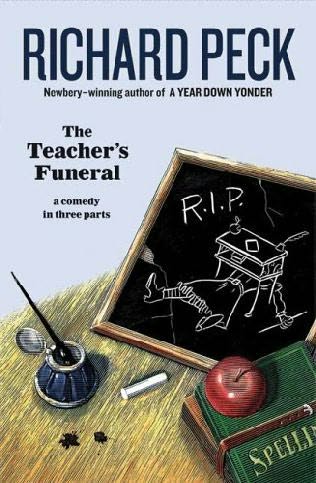
Richard Peck is an amazing writer of historical fiction. And
ON THE WINGS OF HEROES is nostalgia at its best. Set during the early forties, in the days before and after the bombing of Pearl Harbor, it captures the life of an American family in a small town. Our narrator, Davy Bowman, is a young boy who idolizes his father and brother. His brother has recently signed up for the Air Force to be a pilot. The book is about the war and life on the homefront, but it is about so much more. It is about growing up, living life, and having plenty of ordinary adventures along the way. For example, while it talks about the war--the bombing of Pearl Harbor, the brother signing up to go to war, the war rations on food and tires and so forth, it is also about Halloween and Christmas and 'scary' neighbors and even scarier teachers.
Downstairs, the tree lights were on, though daylight poured in. All the Made-in-Japan glass balls on the tree glittered in their prewar way. We were all there in our bathrobes. But right in front of the tree was a bicycle. the kickstand dug into the living room rug. It took me a second because the room went blurry. But it was a bike, painted a gloss black with a thin silver stripe. Not quite a Schwinn, but not that heavy--leaner, faster-looking. I didn't want to move or say anything. I might wake up. Then I saw that it was Bill's old bike. The tires were a little smooth. But the paint job was showroom fresh, hardly dry. And where did those chrome fenders, front and back, come from? They were new, or off some other bike. Dad must have looked around for them. And that stitched-leather seat? The handlebars had seized up with rust long ago, but now they were sanded down, and the bell was new, and the grips. Hanging down below the rear reflector was a squirrel tail. A real one, off a squirrel. "Is it mine?" I said. And they said yes.
We got through the morning and the other presents. I handed out the pen wipers. Finally the four of us were outside on the driveway with the bike. It was cold, but there was noice underfoot. If this had been a real dream, I'd have climbed on and ridden away down the drive, down the street, into the world without a wobble. I'd been on bikes before, other people's and junior-size. But I'd fallen right offand crusted both knees. This bike of mine was full-size. Somebody had built up the pedals with wood chunks. Dad held the handlebars while I climbed on. the seat fit that part of me like a glove. The balls of my feet grazed thebuilt-up pedals. But it felt like I was up a tree, and the concrete on the drive looked far away and hard. Bill stood a bike's-length away, but not near enough. Dad gave a push, the front wheel went sideways, and over I went. Over and over. But we kept at it. I was wringing wet under my layers, and they were working overtime not to laugh. But we stuck to it. I was going to find the balance, learn to ride. It was part of my present, and the day. Back and forth I wobbled, from pair of big hands to another. Mom watched, dancing out of danger in that graceful way she had, because I went in every direction. Just for a flash I found it. The wheels and I aligned. I zipped past Bill and rode the length of the house before I sprawled off and the bike fell on me. And that hurt, but I didn't let on. By the time they got to me, I was up and climbing, stumbling over the chain guard. Then it worked for sure. I'd started back by the garage, and I was still on and steering when I came down the slope of the drive to the street. There were no hand brakes then. You back-pedaled to stop. I forgot and barreled across the street into the Blanchard's driveway before I fell off. But I was like the Wright Brothers, both of them, at Kittyhawk. I'd flown this far. I turned the bike, alone here on this side of the street. I was sucking wind, blowing steam. And there coming up the street was Scooter, red-faced in a stocking cap. He was on the Schwinn from Black's window. On and off it. And his dad was running along behind, picking him up, putting him on again. But Scooter was biking too, almost, and on that brand-new Schwinn with the two-tone paint job and the headlight like a tiny torpedo. He usually did pretty well for presents. And it was all right. It was swell. We both had bikes, and mine was Bill's. (32-35)
Review by Becky Laney, frequent contributor